My First Experience With Loss
When you are young, you don’t think about death. You don’t think that the people you love won’t be with you forever. It’s in the movies. You read about it in books. It’s on the news every day. But until you experience the loss of a loved one, it never seems real. Life seems like it will never end. It’s intangible.
Death, sickness, accidents, disease–they all seem like something that happens to other people. I was 11 when I experienced my first significant loss. The first person I had been close to — my Gram — was no longer there. She wasn’t my Gram by blood, but she was family to me.
Oliver Watson Home

I grew up in the Oliver Watson home, which was a unique experience compared to most children. The Oliver Watson Home was a large, white, two-story colonial house, built in the 1800s. It was just under 3,000 square feet and had seven bedrooms, a kitchen, pantry, dining room, living room on both floors and a secret stairwell. I spent many hours in that secret stairway, playing hide and seek and other imaginary games. There was a large screened-in porch, which I often hid underneath. The work shed out back was where my father would do his woodwork, listening to his old country music and sipping his Budweiser bottle. The smell of sawdust wafting in the air. One scent of sawdust brings me back there.
There were cows kept in the large barn out back. We would often get phone calls from the neighbors inquiring if we had recently lost our cow, as someone had spotted it wandering down the road, roaming through the neighborhood.
A garden ran along the side of the house where my dad would tend to his tomatoes and radishes. Across from the garden grew honeysuckle bushes. I would pick off the flowers and suck out the sweet juices. A white picket fence bordered the front yard, and at either side of the driveway stood large stone pillars with flat surfaced tops, perfect for sitting on. I would climb up the side, using the iron rungs as steps, and sit on the top. Watching and waving to the neighbors, I felt I was on top of the world. When I went back as an adult, however, I realized it was not that big.
I spent the first 10 years of my life at The Oliver Watson Home. Somewhat like an assisted living facility for elderly, it housed four elderly people who lived downstairs, and my family and I lived upstairs. My mother was the caretaker and did all the cooking, cleaning, and laundry. She would take the residents on appointments and tend to their needs. The residents could take care of themselves, for the most part.
Residents
Over time, many residents came and went. There was Arthur, a Polish man who told painfully horrible jokes. The same ones. Over and over. And over again. There was one joke he told every time I walked by him. “What did the cow say to the farmer?” he asked. “Hurry and milk me so I can chew my cud.” As an adult, it was the worst joke ever. As a kid, I didn’t understand it, so I didn’t know how painfully bad it was. This is most likely why, at the early age of five, I had nicknamed him “Arthur-itis.”
One night, my mother awoke to a male resident taking a shower in my child sized coat. Don’t ask me how he ever fit into a 5-year-old little girl’s coat or why he was wearing nothing else under it! Maybe I should ask why he was wearing a coat in the shower. It must have been quite the sight for my mother to wake up to.
There was Herb, who was always reading the paper or sitting in his car. He was the only resident who had his own car. He portrayed himself as somewhat of a grumpy old man, but when I would visit his room, I would somehow coerce him into tickling my feet. As an adult, it seems like a strange request, but somehow, he always played along. Kids have a way of softening a grumpy old man and bringing out the playful side.
Just across the hall was Betty. She spent her day crocheting doilies and always kept a jar filled with gum in her room. I was welcome to take a piece of gum; however, I once tried to sneak a second piece. To this day, I don’t know how Betty caught me. The woman was blind as a bat! I may not have been as stealthy as I thought.

Gram
Over time, many residents came and went. Each with their own quirks and personalities. Their own unique stories. Yet only one was forever ingrained in my heart.
The one who called me her “Million Dollar Baby” with “perfect legs.” The one who would play restaurant with me and give me real coins for tips. The one spending nights watching Wheel of Fortune, scratching my back with her razor-sharp fingernails, and drinking root beer floats. The one who would spoil me with books and dolls and butterscotch candies.
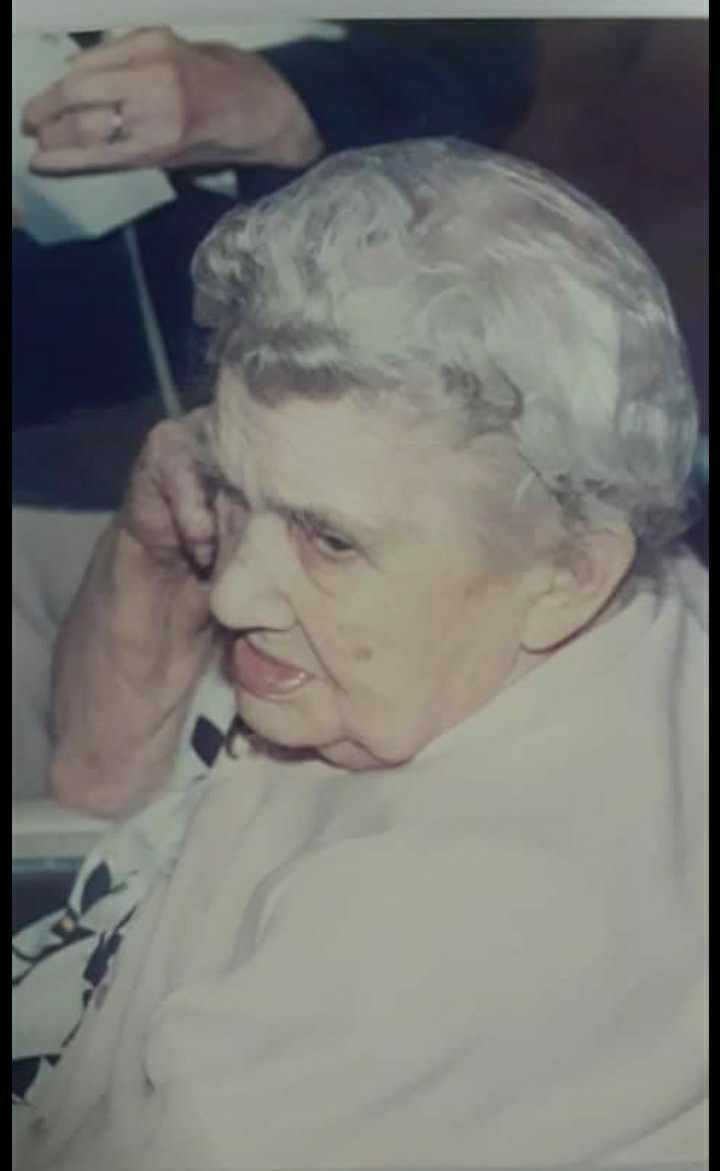
That one was my Gram, Ina Hayward. In her eyes, I could do no wrong. No child could compare to me. She thought I was so beautiful.
So smart.
So perfect.
It’s amazing how I can read these words today and think, God, why can’t I see myself as Gram saw me? As women, as humans, it can take us decades to be okay with being our perfectly flawed selves.
Some never do.
But Gram loved me to death. She may not have been blood, but she was part of my life. I lived with her from the time I was six months old until I was 10.
Moving
After 10 years of full-time caretaking, my mother was ready for a break. She needed a job she could at least escape from. She needed to move on.
I don’t remember if I was sad to leave that house, but I remember being excited to move into our new home. It was on the other side of the tracks. Same town. Same school. Same friends.
I was so excited to move next door to my cousins. I thought little about the fact that I would leave Gram. As children, we don’t realize how change works. I figured she would still be there, and I would visit. My brain didn’t compute the changes to come in the next few months. The changes that life can bring.
Over the next few months, I was adjusting to my new home and the fun of living next door to my cousins. We would play board games and dolls and walkie talkies. The days of the Watson Home faded from memory.
I recall my mother telling me Gram had to move out of the house after we left. She was in her mid-90s and no longer self-sufficient. She hadn’t been for some time, however; she had become like family to us.
They moved Gram into a nursing home just the next town over, and I remember visiting her there a few times. I would also write her letters on the special personalized stationery she had given me–single sheets of lined paper with a little blonde girl in a dress in the top left-hand corner. I still have a couple of pieces of that stationery tucked away.

Letters
One with the last letter I had written to Gram. That letter never quite made it to her. Maybe this is where my love of writing letters started.
It was early summer, a June day, and I had just returned from day camp when my mom delivered the news. I clearly remember standing in the driveway, basketball in my hand while I practiced my shooting skills. My reaction or what happened after isn’t clear in my memory. I am told there was a memorial, but I recall little else.
The details are not clear in my memory. What I remember is the gradual procession of our lives, drifting apart, which in retrospect was a positive thing.
It was the moment I realized people won’t always be with you. That sometimes we hold on to the tangible gifts people give us only because we are afraid of the intangible memories leaving us.
When someone is such a monumental part of our lives, they are never gone or forgotten. No matter how much time passes, they are ingrained in our hearts. When someone has touched our souls and left footprints on the sands of our lives, they will never leave our memory.
Even today, over 30 years later, I can close my eyes and smell the sweet honeysuckle outside the window, feel her razor-sharp fingernails on my back, and picture her in her recliner rocker, with her navy-blue dress covered in white polka dots, walker in front of her. And if I listen closely, I can hear her in a soft whisper, calling me her “Million Dollar Baby” one more time.
Find my last post here
I recorded my first audio of this series. Help me out by following on Spotify! Spotify is free, and so is following. Just by following, you can help me monetize my podcast and support my writing (and talking) dreams!


 Adventures of the Traveling Grief Case
Leave a Reply